
SEA & SKY FEATURED REVIEW
Celestron StarSense Explorer DX 130AZ
Sonark verdict: a strong first serious telescope for beginners who want help finding objects without paying for a motorized GoTo mount.
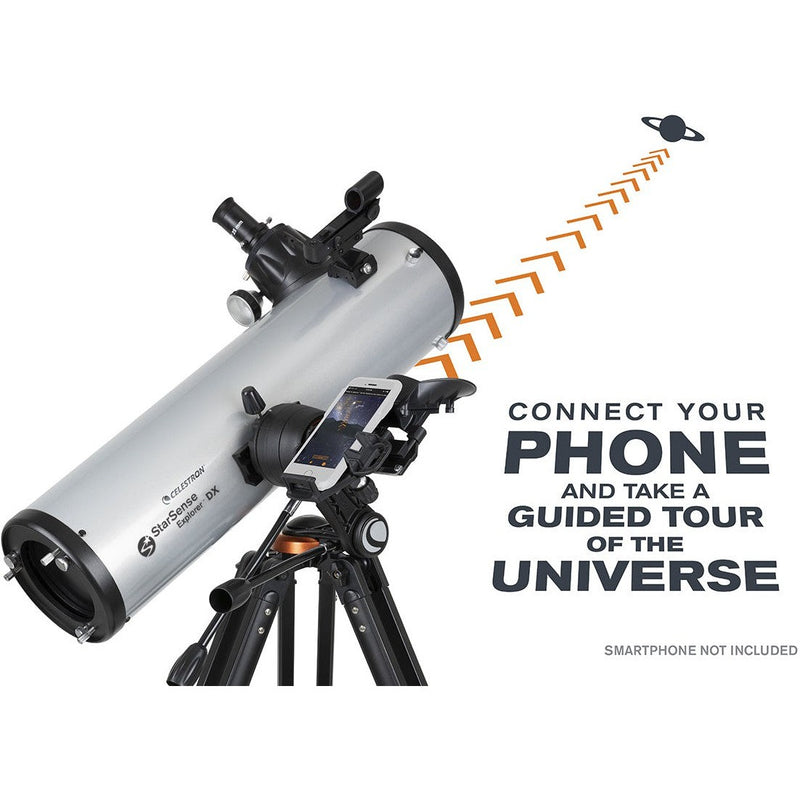
Why this model stands out
The StarSense system uses a smartphone dock and app to help determine where the telescope is pointed and guide you toward visible objects. That solves one of the biggest beginner frustrations—finding a target—while the telescope itself remains manually aimed. The 130 mm parabolic primary mirror provides substantially more light-gathering ability than small starter refractors.
What we like
- 130 mm aperture is useful for the Moon, planets, star clusters, and brighter nebulae and galaxies.
- StarSense guidance makes target finding easier for a beginner.
- Dual-axis slow-motion controls help center and follow objects.
- The mount does not require power; only the phone does.
- At about 18 lb for the complete kit, it remains portable enough for backyard or darker-sky trips.
Tradeoffs to know
- Tracking is manual, so objects drift and must be followed by hand.
- A Newtonian reflector occasionally needs collimation.
- The included 25 mm and 10 mm eyepieces provide 26× and 65×; buyers interested in higher-power planetary viewing may eventually want another eyepiece or Barlow lens.
- The undriven alt-az mount is not intended for long-exposure deep-sky astrophotography.
What can you realistically see?
Under ordinary suburban skies, the Moon and bright planets are the easiest high-impact targets. Celestron specifically lists Jupiter, Saturn, Venus, the Orion Nebula, double stars, and other bright objects as practical targets. Darker skies make fainter deep-sky objects easier to see. Expectations still matter: visual astronomy does not look like long-exposure astrophotography, but a 130 mm reflector can show far more than the naked eye.
Who should buy it?
This is a particularly good fit for someone who wants to learn the sky but worries about not being able to find anything. It keeps the mechanical side straightforward while using the phone as a guide. A fully computerized telescope may be better for someone who wants automated slewing and tracking, while a simpler refractor may be better for someone who values almost no optical maintenance.
Sonark recommendation
For a beginner choosing between a very small starter scope and a complicated computerized system, the StarSense Explorer DX 130AZ hits a useful middle ground: enough aperture to stay interesting, guidance that reduces frustration, and a manual mount that keeps setup understandable.